
Indian markets started 2012 on a positive note. Ridham Desai, managing director and strategist and head of India equity research, Morgan Stanley, says, he expects a 15 per cent upside in the Sensex this year.

The last four years, the best for corporate profits in a long time, have not been as impressive for corporate capital expenditure. The combined net profits of India's top listed companies excluding banks, financial services, and insurance (BFSI) increased at a compound annual growth rate (CAGR) of 32.4 per cent since FY20, a sharp jump from the 7.4 per cent in corporate earnings between FY14 and FY19.

Most of the Sensex firms settled in the positive territory. Mahindra & Mahindra, Tata Motors, Tech Mahindra, JSW Steel, State Bank of India, HCL Technologies, Reliance Industries and Infosys were the biggest gainers. Kotak Mahindra Bank and Maruti were the laggards.

While the four largest listed paint companies have seen marginal negative returns, the S&P BSE Fast Moving Consumer Goods (FMCG) and the National Stock Exchange Nifty FMCG indices have delivered a solid 16 per cent return during the same period. Initially, volume growth and reduced costs bolstered the sector's sentiment, but brokerages have grown cautious due to increased competitive pressures.

Among the Sensex firms, Titan, Asian Paints, ITC, Hindustan Unilever, Nestle India, Bajaj Finserv and Bharti Airtel were among the gainers. In contrast, UltraTech Cement, Tech Mahindra, Tata Steel, Power Grid, HDFC Bank, HCL Technology, State Bank of India and ICICI Bank were the laggards.

Benchmark equity indices Sensex and Nifty pared early gains to settle lower on Wednesday due to late selling in index major Reliance Industries, ITC and HDFC Bank even as the RBI took the first step towards a rate cut in its monetary policy review. Erasing its early gains, the 30-share BSE Sensex fell 167.71 points or 0.21 per cent to close at 81,467.1. During the day, it surged 684.4 points or 0.83 per cent to hit an intra-day high of 82,319.21.

The majority of active largecap funds are set to outperform for the second year in a row in 2024, thanks to the strong performance of their midcap and smallcap allocations.

The Reserve Bank of India's (RBI's) interest rate decision, West Asia conflict and trading activity of foreign investors are the key factors that will dictate investors' sentiment in the market this week, analysts said. Moreover, quarterly earnings from IT bellwether TCS, domestic macroeconomic data and movement in global oil benchmark Brent crude would also guide trends in the market. Worsening tensions in the Middle East and foreign fund outflows were the major culprits behind the equity markets sharp fall last week.
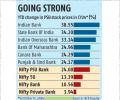
Stock Market News today, PSU banks: The year 2024 was a roller-coaster ride for Indian stock markets, marked by volatility driven by the Lok Sabha elections, Union Budget 2024, a slowdown in corporate earnings, and sticky inflation. Geopolitical tensions - particularly between Israel and Iran in West Asia - along with various stimulus announcements by China and yen carry trade rocked the equity markets throughout the year.

The ongoing fourth quarter earnings season, global factors and macroeconomic data would guide the trends in the equity markets this week, analysts said. Markets would also take cues from trading activity of foreign investors, rupee-dollar trend and movement of global oil benchmark Brent crude. "Domestically, the next batch of Q4 earnings reports will drive stock-specific movements, Hero MotoCorp, Larsen & Toubro, BPCL, State Bank of India, Eicher Motors and Tata Motors are some of the big names in the list and the next phase of voting," said Pravesh Gour, senior technical analyst, Swastika Investmart Ltd.

Investors' wealth on Monday surged Rs 4.21 lakh crore as markets bounced back after five days of fall. The BSE Sensex jumped 602.75 points or 0.76 per cent to settle at 80,005.04. During the day, it surged 1,137.52 points or 1.43 per cent to 80,539.81.

From the 30 Sensex firms, Mahindra & Mahindra, Infosys, Kotak Mahindra Bank, JSW Steel, Adani Ports, Tata Motors, Adani Ports, ITC and Titan were the major laggards. HDFC Bank, Bharti Airtel, Reliance Industries, Asian Paints and State Bank of India were the gainers.

Market chatter suggests that the BJP could win fewer than 300.

Mutual funds (MFs) invested a record Rs 1.73 trillion in equities in the financial year 2022-23 (FY23), providing strong support to the Indian markets at a time when foreign investors were redeeming their holdings. They exceeded the previous high of nearly Rs 1.72 trillion investment in equities in FY22. The data from the Securities and Exchange Board of India (Sebi) shows MFs were net buyers in the equity market in eleven of the twelve months last financial year.

'India's top companies currently lack the organisational wherewithal to hire and train 2 million interns annually, given their current scale of operations and existing employee base.'

The primary market is expected to remain vibrant, with at least 10 companies, including supermart major Vishal Mega Mart and Blackstone-owned diamond grading firm International Gemmological Institute (India) Ltd expected to raise a combined Rs 20,000 crore in the next month, merchant bankers said. Education-focused NBFC Avanse Financial Services, TPG Capital-backed Sai Life Sciences, hospital chain operator Paras Healthcare, and investment bank DAM Capital Advisors are also among the companies planning to launch their IPOs in December, they added. The companies aim to raise a total of Rs 20,000 crore through their public offerings.

Many investors want to exit equities now and re-enter when they begin to rise. Such timing is difficult to pull off.

The US Federal Reserve's interest rate decision is the biggest event that would drive sentiments in the domestic stock market this week, besides a host of macroeconomic data from the global front and trading activity of foreign investors, analysts said. The Indian equity market had an exceptional last week, with both the Nifty and Sensex hitting their all-time high levels on Thursday.

Dalal Street investors became richer by more than Rs 16.36 lakh crore this year as the equity market scaled new highs despite persistent geopolitical uncertainties and inflation worries. Analysts attributed better macroeconomic fundamentals, the confidence of retail investors and foreign investors investing again in the domestic equities towards the latter half of 2022 as the key factors that led to the outperformance of the Indian market in comparison to many other stock markets worldwide. During the initial part of the year, markets were jolted by the Russia-Ukraine war.
Quarterly earnings from corporates, the US Fed interest rate decision and other global trends will be the major driving factors for determining movement in the domestic equity market in a holiday-shortened week ahead, analysts said. Besides, factors like trading activity of foreign investors, global oil benchmark Brent crude and rupee-dollar trend would also influence trading.

From the 30-share blue-chip pack, Adani Ports jumped over 5 per cent. NTPC, Tata Steel, Bajaj Finserv, Zomato, Bajaj Finance, Tata Motors, State Bank of India, IndusInd Bank and Maruti were among the other big gainers. From the 30-share pack, Hindustan Unilever, Titan, Tata Consultancy Services, Infosys and UltraTech Cement were the other laggards.

From the 30 Sensex firms, Tata Consultancy Services and HCL Technologies dropped over 3 per cent each. Infosys, Tech Mahindra, Sun Pharma and Tata Motors were the other major laggards. Bajaj Finance, Bajaj Finserv, Nestle, HDFC Bank, ICICI Bank and State Bank of India were among the biggest gainers.

Multi-asset allocation funds emerged as the most popular option for MFs as they provided the needed flexibility.

As regards India, FIIs have pumped in over Rs 34,400 crore in the Indian stocks in calendar year 2021.
In a data-packed week, the domestic macroeconomic figures -- industrial production and inflation numbers -- along with global trends would dictate trends in the equity market this week, analysts said. According to experts, markets may face volatile trends due to high valuations. Equity benchmark indices Sensex and Nifty hit their fresh record peaks on Thursday. Besides, trading activity of foreign investors, movement of global oil benchmark Brent crude and rupee-dollar trend would also influence trading in equities.

The November 5 US presidential elections, Federal Reserve interest rate decision, trading activity of foreign investors, and the upcoming quarterly earnings from domestic firms are the major triggers that would influence sentiments in the equity market this week, analysts said. In an eventful week ahead, a host of macroeconomic data announcements and global trends would also drive the markets, experts said. "The upcoming week is poised to be eventful on the global front.

SBI Mutual Fund recently launched the SBI Quant Fund. Its new fund offer (NFO) opened on December 4, 2024, and will close on December 18, 2024. Currently, 11 fund houses manage quant funds with assets worth Rs 9,013.6 crore.

'Regardless of whether you invest Rs 100 or Rs 1 crore per month, risk is inevitable.' 'Positive returns at the end of the year can never be guaranteed.' 'This is a fundamental truth every SIP investor must grasp.'

Among the 30-share Sensex blue-chip pack, Bharti Airtel, ITC, Kotak Mahindra Bank, Hindustan Unilever, Titan, UltraTech Cement, HCL Technologies, and Power Grid, were the biggest gainers. Tata Steel, IndusInd Bank, JSW Steel and Bajaj Finserv were the laggards.

2023 could be another volatile year for Indian equity markets, according to BofA. In a report, the brokerage pointed out that the Nifty50, at present, is trading at 20.7x against its long-term average of 18.8x one-year forward earnings of current Nifty constituents. Plus, India is trading at a 98 per cent premium to its emerging market (EM) peers against its long-term average of 45 per cent.
Undeterred by the stock market volatility, uncertainty due to the Ukraine-Russia war and high inflation, equity mutual funds continue to remain attractive choice for investors for the 15th straight month, registering a net inflow of Rs 18,529 crore in May on robust SIP numbers. This was higher than Rs 15,890 crore net inflow in April, data from the Association of Mutual Funds in India (AMFI) showed on Thursday. Equity schemes have been witnessing net inflow since March 2021, highlighting the positive sentiment among investors.

The sharp correction in the Indian markets from their peak levels has made valuations attractive, say analysts, who advise buying selectively, but only from a long-term perspective. Fifty-six of the Nifty 100 stocks, according to Mahesh Nandurkar, managing director at Jefferies, now trade below the 10-year historical averages, including stocks in financial, select auto, and pharma sectors. "Valuation (one-year forward consensus price-to-earnings, PE) has declined 25 per cent from October 2021 peak, almost matching the 33 per cent price-earnings contraction during the 2011 tightening cycle when repo rates went up by 375 basis points (bps) versus 250 bps this cycle.
The Reserve Bank of India's interest rate decision, domestic macroeconomic data and global trends will dictate terms in the equity markets this week, analysts said. Trading activity of Foreign Portfolio Investors (FPIs) will also influence markets, they added. "The Indian market will be closely monitoring the Reserve Bank of India's Monetary Policy Committee (MPC) meeting scheduled for June 6-8, 2023. Aside from that, market participants will be keeping an eye on the progress of monsoon," said Pravesh Gour, Senior Technical Analyst, Swastika Investmart Ltd.
RBI interest rate decision, macroeconomic data and global trends would guide markets' movement this week, analysts said. Besides, trading activity of foreign investors and the last batch of Q1 earnings announcements would also guide trends in equities. HSBC PMI (Purchasing Managers' Index) for the services sector is scheduled to be announced on Monday.

Inflow in equity mutual funds halved to Rs 3,240 crore in May, declining for the second consecutive month, primarily due to profit booking by investors amid rising market. However, this was also the 27th consecutive month of inflow in the equity class, which was primarily driven by fund infusion in small-cap and mid-cap categories, data released by the Association of Mutual Funds in India (Amfi) showed on Friday. Overall, the 42-player mutual fund industry continues to see inflow and attracted Rs 57,420 crore, on contributions from debt-oriented schemes.
Indian equity markets should be able to withstand inflation up to 8 per cent, said analysts at Credit Suisse Wealth Management in a recent note. Should the rate of inflation move higher than this, the valuation of Indian equities could deteriorate further, they cautioned. The fall from the peak levels has seen Nifty's 12-month forward price-to-earnings (P/E) ratio of 17.6 dip toward its 10-year and 5-year (pre-COVID) average of 16.9, which suggests that valuation froth of Indian equities has settled, said the Credit Suisse analysts.

From the 30 Sensex firms, NTPC, Nestle, Titan, Kotak Mahindra Bank, Maruti, Hindustan Unilever, Bharti Airtel and HDFC Bank were the biggest gainers. HCL Technologies, Tata Consultancy Services, Adani Ports, Larsen & Toubro, JSW Steel, State Bank of India, Tech Mahindra and Bajaj Finance were among the laggards from the pack.

Investors' wealth climbed Rs 3.20 lakh crore as markets staged a smart comeback on Wednesday after falling in the last eight trading sessions. The BSE Sensex rallied 448.96 points or 0.76 per cent to settle at 59,411.08. During the day, it jumped 513.33 points or 0.87 per cent to 59,475.45.

Seven consecutive sessions of decline in the equity market has eroded the wealth of investors by a whopping Rs 10.42 lakh crore and the benchmark Sensex has tumbled more than 2,000 points during this period. Concerns over more rate hikes by developed economies, weak global equity markets and fresh foreign fund outflows from the domestic market have dented investor sentiments. On Monday, the BSE Sensex dropped 175.58 points or 0.30 per cent to end at 59,288.35 points, marking a decline for seven straight trading sessions.

The beleaguered Deutsche Bank announced major overhaul of its business, which included discontinuing loss-making equities trading business, creating a new 'bad bank', and cutting 18,000 jobs. Deutsche Equities India employs 35 people, all of whom could face the job axe.
